

Ask a handful of people how much water you should drink each day and most will give the same answer: eight glasses. It is one of the most repeated pieces of health advice in the world. The problem is that people are not all the same. We do not live in the same climate, do the same jobs, exercise the same amount or eat the same food, yet hydration advice is usually presented as if one number fits everyone.
The reality is more interesting. Some people genuinely need more water than others, some less, and your own needs change with the season, where you work, how active you are and even what you had for lunch. So if you have ever wondered how much water you should drink a day, the honest answer is not a fixed number. It is understanding what drives your needs and building a habit that fits your life.
Short answer: UK guidance (NHS) is 6 to 8 glasses of fluid a day, roughly 1.2 to 1.5 litres from drinks, on top of the water in food. European guidance puts total daily water at about 2 litres for women and 2.5 litres for men, including the 20 to 30% that comes from food. All fluids count, including tea and coffee. Add 500 ml to 1 litre for every hour of hard exercise or hot outdoor work. In practice, if you drink regularly through the day and your urine is pale straw-coloured, you are getting enough.
Why there is no single perfect hydration target
The NHS recommends around six to eight glasses of fluid a day. The European Food Safety Authority suggests about 2 litres of total water daily for women and 2.5 litres for men under typical conditions. US guidance from the National Academies is higher still, at 2.7 and 3.7 litres of total water. The numbers differ partly because they measure different things.
| Source | Women | Men | What it counts |
|---|---|---|---|
| NHS Eatwell Guide (UK) | 6 to 8 glasses a day (about 1.2 to 1.5 litres) | Drinks only; food adds more on top | |
| EFSA (Europe) | 2.0 litres | 2.5 litres | Total water, including about 20 to 30% from food |
| US National Academies | 2.7 litres | 3.7 litres | Total water from all drinks and food |
Notice the word fluid. It does not mean water alone. Tea, coffee, milk, sparkling water, squash and the water in fruit, vegetables, soup and yoghurt all contribute. A 2022 study in the journal Science measured water turnover in more than 5,600 people across 26 countries and found enormous variation, from about 1 to 6 litres a day, driven by body size, age, activity, climate, altitude and occupation. There is no universal target. The useful question is whether you drink consistently through the day and respond to your body.
How much water should you drink a day based on your lifestyle?
A desk-based office worker and a landscaper working outdoors in July have very different needs. The table gives sensible starting points for drinks (not counting food), and how that translates into refills of a typical bottle.
| Who | Drinks per day (starting point) | Refills of a 750 ml bottle | What raises it |
|---|---|---|---|
| Office worker, air-conditioned, low activity | 1.5 to 2 litres | 2 to 3 | Heating or air-con dryness, long meetings with no breaks |
| Gym-goer or runner | 2 to 3 litres | 3 to 4 | Add 500 ml to 1 litre per hour of hard training; more in heat |
| Parent on the school run and errands | 1.5 to 2 litres | 2 to 3 | Forgetting rather than need; keep the bottle in the car or pram |
| Student, long study days | 1.5 to 2 litres | 2 to 3 | Exams and caffeine-heavy days; sip while studying |
| Outdoor or manual worker in summer | 3 litres or more | 4 or more | Sweat loss of 0.5 to 1 litre an hour; add electrolytes on long shifts |
| Older adult | 1.5 to 2 litres | 2 to 3 | Thirst signals weaken with age; drink to a schedule |
Office workers are rarely short of water because they sweat; they are short because they forget. Back-to-back calls and screens make drinking an afterthought until mid-afternoon. Gym-goers and outdoor workers have the opposite problem: real losses that plain water alone does not always replace on long hot days. Parents and students sit in between, where the fix is almost always proximity, a bottle within reach rather than a bigger target.
Signs you are not drinking enough
Even mild dehydration (a 1 to 2% drop in body water) has been associated in research with reduced concentration, lower alertness, headaches and tiredness. The difficulty is that these symptoms get blamed on stress, poor sleep or a long day.
- Headache, especially mid-afternoon
- Tiredness or a dip in energy without an obvious cause
- Difficulty concentrating
- Dry mouth or lips
- Urine that is dark yellow rather than pale straw
- Going to the toilet fewer than four times a day
Urine colour is the simplest check: pale straw means you are fine, dark yellow means drink, and completely clear all day means you may be drinking more than you need. Sometimes the answer to a slump really is a glass of water, and the fix is consistency rather than a dramatic increase.
The workplace hydration problem nobody talks about
Hydration is treated as a personal responsibility, but workplaces shape it more than most people realise. Someone arrives, sits down, attends three meetings, answers dozens of emails and stares at a screen for hours. By mid-afternoon they have barely touched a drink. Hydration will not solve every productivity problem, but it is one of the simplest wellbeing factors an employer can influence.
That is why more companies invest in it: better refill stations, reusable bottles in onboarding kits, hydration built into wellbeing and sustainability programmes. A bottle on the desk acts as a visual cue all day, and that cue is often enough. It is also why branded water bottles have become such common corporate gifts: when employees actually use them, they serve wellbeing and sustainability goals at once. Our post on why corporate water bottles fail internally covers how to choose one that gets used rather than filed in a drawer.
Is drinking lemon and water good for you?
One of the most searched hydration questions. The answer is simple: the main benefit is the water. Lemon does not turn water into a health elixir, but it can make water more enjoyable, and for people who struggle with plain water that is a real advantage. Lemon adds a little vitamin C and flavour without meaningful calories. The one caution is that acidic drinks can wear tooth enamel over time, so drink it through a straw or rinse with plain water afterwards, and do not brush straight after. If lemon water helps you drink more overall, it is doing exactly what you need.
The benefits of drinking hot water
The internet makes bold claims about hot water. The reality is simpler: hot water is not inherently healthier than cold. What it does is help some people drink more, particularly in winter when iced drinks are unappealing. Many people like starting the day with warm water because it is comforting and easy to drink first thing; others find it keeps them hydrated in months when they naturally drink less. The benefit is behavioural rather than biological, and that still counts. An insulated bottle that holds a hot drink for 12 hours makes the habit practical away from a kettle.
Why your bottle matters more than the target
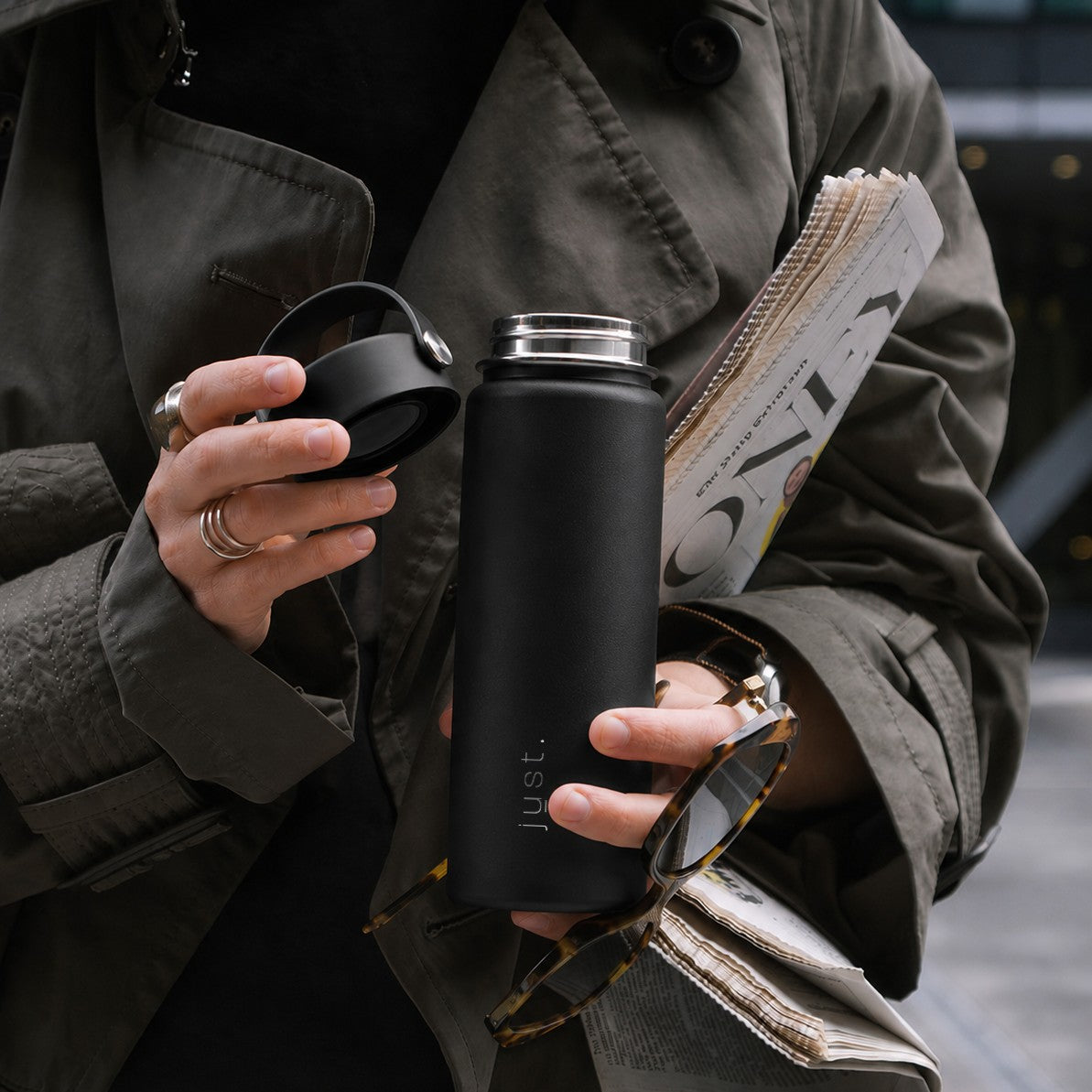
Most hydration advice is about litres. What gets overlooked is the bottle. The easiest bottle to drink from is the one that gets used most. A large insulated bottle suits desk-based people who do not want to refill; a straw lid encourages frequent sipping; glass appeals to people who want a neutral taste; others want portability above all. Our customers often say they started drinking more without trying, simply because they switched to a bottle they liked using.
The 1 L Nomad Bottle is popular with people who want all-day hydration without refills. The Titan Tumbler has become a desk fixture for office workers. For glass, the Just Bottle x Aleks Petrović bottle pairs a straw lid and carry handle with a generous capacity. Our guide to the best water bottle for every type of person matches bottle to routine, and do big water bottles make you drink more looks at whether size helps. The point is not that one bottle is perfect for everyone; it is that the right bottle makes hydration easy, and easy habits last.
What your habits are probably telling you
Most people do not need to obsess over litres, apps or schedules. Consistency matters. If you drink regularly through the day, your urine is generally pale, your energy is stable and you are not constantly thirsty, you are probably fine. For individuals that means paying attention to lifestyle, activity and environment. For businesses it means recognising that workplace design, bottle accessibility and simple wellbeing initiatives all influence how much people drink. The goal is not perfection. It is making hydration effortless enough that you rarely think about it. Our hydration tools and guides page has calculators if you want a personal estimate.
And every bottle that replaces a disposable counts twice: every 100 bottles ordered from Just Bottle funds the collection of 10 kg of ocean-bound plastic through Plastic Bank, roughly 500 plastic bottles kept out of the sea.
Frequently asked questions
How much water should you drink a day in the UK?
The NHS advises 6 to 8 glasses of fluid a day, about 1.2 to 1.5 litres from drinks, plus the water in food. European guidance puts total water at around 2 litres for women and 2.5 for men including food. Adjust upwards for exercise, heat and manual work.
Does tea and coffee count towards your water intake?
Yes. The NHS counts tea, coffee, milk, sugar-free squash and sparkling water as fluid. Caffeine has a mild diuretic effect but moderate intake (up to about four cups of coffee a day) still leaves you with a net gain of fluid.
How much water should you drink when exercising?
Roughly 500 ml to 1 litre per hour of hard exercise, more in heat, on top of your normal intake. For sessions over about 90 minutes, or heavy sweating, add electrolytes rather than relying on water alone.
Can you drink too much water?
Yes, though it is rare in everyday life. Drinking several litres in a short period, especially during endurance exercise without replacing salt, can dilute blood sodium (hyponatraemia). Drinking to thirst and to a pale urine colour avoids both extremes.
Is lemon water better than plain water?
Not nutritionally in any meaningful way. Its value is making water more appealing so you drink more. Use a straw or rinse afterwards to protect tooth enamel from the acid.
How many bottles of water a day is 2 litres?
About four 500 ml bottles, three 750 ml bottles, or two 1 litre bottles. A single 1 litre insulated bottle refilled once at lunch is the simplest way for most office workers to hit the target without counting.
Ready to make hydration easier?
Whether you want a reusable bottle for everyday use, a larger tumbler for long workdays, or branded bottles for an employee wellbeing programme, explore our reusable water bottles and custom logo bottles and find one you will want to carry every day.