

Have you noticed how much easier it is to finish a bottle of ice-cold water than one that has been sitting on your desk all morning? Most of us have. We reach for chilled water after a workout, on a hot day or during a long afternoon at work. It feels crisp, refreshing and somehow more satisfying. Is that just preference, or is there science behind it?
Researchers have spent years on exactly this question. Cold water is not inherently healthier than room-temperature water, but studies consistently find that people drink more when water is chilled. Most of the benefits of drinking cold water come from that one fact: if you enjoy drinking it, you stay better hydrated, and hydration supports everything from concentration and energy to physical performance. Here is what the research says, what is myth, and why keeping water cold helps build the habit.
Short answer: yes, cold water is good for you, mainly because people drink more of it. Your body absorbs water the same at any temperature, but chilled water (roughly 10 to 15 °C) feels more refreshing, is preferred in choice studies, and in exercise research helps limit the rise in core temperature so hot workouts feel easier. The metabolism effect is real but tiny, and the idea that cold water harms digestion has no good evidence in healthy adults. The best temperature is the one that gets you to drink consistently, which for most people is cold.
Why does cold water feel so much more refreshing?
There is a reason cold water feels irresistible after walking in the sun or finishing a hard session. Your body works constantly to hold a stable core temperature, and exercise, time outdoors or a warm office all push it up. Drinking something cold creates an immediate cooling sensation in the mouth and throat that the brain registers as relief. Cold receptors in the mouth signal "cooling" before the water has been absorbed, which is why the sensation arrives within seconds. That is why cold water feels more rewarding than warm water in summer or after activity. Researchers also find that people given a choice usually pick colder drinks, not because they are thirstier but because chilled water is more enjoyable, and we do more of what we enjoy.
The real reason cold water helps you stay hydrated
A common misconception is that cold water hydrates you differently. It does not. Chilled, room temperature or warm, your body absorbs water in much the same way. The difference is how much you are willing to drink. Studies of fluid intake during exercise and in warm environments repeatedly find that people drink more when the water is cool, which means you are more likely to hit your daily intake without trying. Think about it: a lukewarm bottle from the car gets one sip and is forgotten; an insulated bottle of ice water gets reached for all afternoon. Better hydration is often not about discipline. It is about making water pleasant to drink.
What the research actually shows
| Claim about cold water | What the evidence says | Verdict |
|---|---|---|
| People drink more when water is cold | Consistent finding in exercise and heat studies; cool water (around 10 to 16 °C) is drunk in greater volumes than warm water | Supported |
| Cold water hydrates you faster or better | No difference in absorption or hydration status by temperature once drunk | Myth |
| Cold water improves performance in heat | Several studies show cold or ice-slurry drinks lower the rise in core temperature and extend time to exhaustion in hot conditions | Supported, modest |
| Cold water boosts metabolism | Measurable thermogenic effect of a few calories per glass; not meaningful for weight | True but trivial |
| Cold water is bad for digestion | No good evidence of harm in healthy adults; water reaches body temperature in the stomach quickly | Myth |
| Cold water makes you feel more alert | Sensory stimulation plus rehydration; small studies report improved alertness after cold drinks | Plausible, mostly sensory |
The proven benefits of drinking cold water
It encourages better hydration. This is by far the biggest advantage. If chilled water gets you to drink an extra few glasses a day, that does more for you than any debate about temperature. Staying hydrated supports concentration, energy, digestion, temperature regulation and everyday physical performance. Cold water is not the magic ingredient; drinking enough water is.
It may improve exercise performance in heat. This is where cold water has been studied most. Exercise generates heat, and if core temperature rises too fast, fatigue sets in sooner. Several studies find that cold drinks during exercise slow that rise, making activity in hot conditions feel easier and extending endurance. It does not make you fitter; it keeps you more comfortable while you work.
It can leave you feeling more alert. Many people reach for a cold drink in the afternoon slump. Part of that is hydration, part is sensory: the cooling sensation wakes you up. It will not replace sleep, but a cold bottle of water is a good alternative to a third coffee.
It burns a tiny amount of energy. Your body uses energy warming cold water to body temperature. The effect is measurable and extremely small, a handful of calories per glass, so it is not a weight-loss strategy. Drink cold water because it helps you drink more, not to burn calories.
Is drinking cold water always the best option?
Not necessarily; context matters. Cold water works best when exercising, outdoors, travelling in warm weather, recovering after activity, or trying to increase daily intake. There are also times when room-temperature or warm water feels more comfortable: first thing in the morning for many people, or through a winter working day. Despite the myths, there is little evidence that cold water harms digestion in healthy people; the stomach warms it quickly. Ultimately the best temperature is the one that gets you to drink consistently.
What about lemon water and hot water?
Two of the most common hydration questions have nothing to do with cold. Is lemon water good for you? Yes, mainly because it gets people to drink more; the vitamin C from a few slices is small, and it is not a detox. Mind your tooth enamel with the acid. Are there benefits to hot water? For many people it is soothing in winter and easier to drink first thing, and herbal tea, warm lemon water and plain hot water all count towards fluid intake. Hot or cold matters less than enough. Our guide to how much water you should drink a day covers both in detail.
Your water bottle might matter more than the water
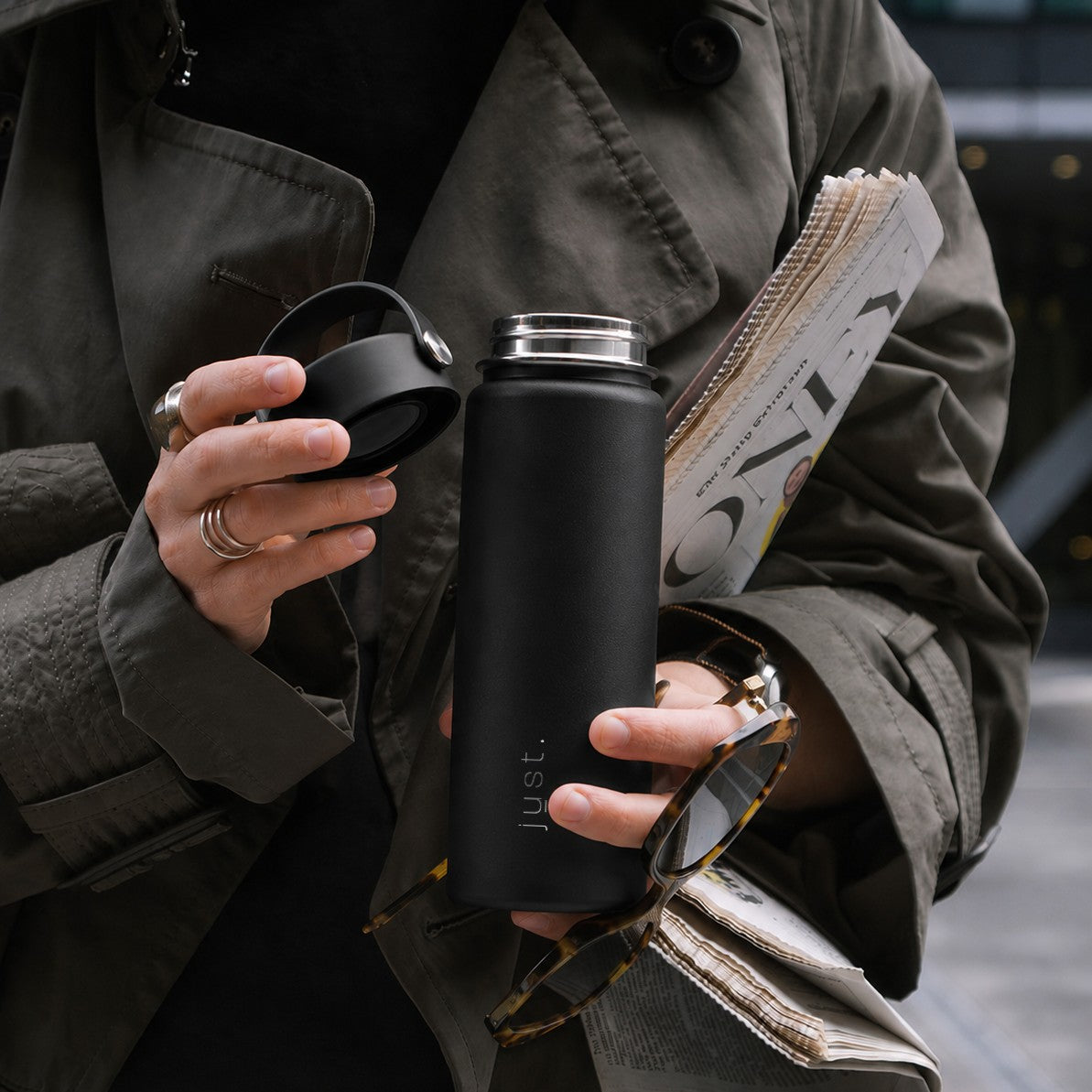
Hydration habits are shaped by convenience as much as intention. If water quickly goes warm you drink less of it. If the bottle leaks, feels awkward or lives at the bottom of a backpack, you drink less. A well-designed insulated bottle keeps water cold for hours, so the afternoon sip is as refreshing as the morning one. For commuters a compact bottle fits a work bag; for the gym or long days outdoors a larger insulated bottle cuts refills; for desk workers a glass bottle is a visual reminder. Businesses are recognising this too, giving branded reusable bottles as part of workplace hydration programmes, because a bottle within arm's reach changes behaviour across a whole office. Insulated bottles and custom insulated tumblers with a logo are the usual choice, because the water is still cold at 4 pm.
At Just Bottle every product is designed around that idea: the TempControl Nomad Bottle keeps drinks cold for up to 24 hours, the Titan Tumbler holds 1.2 litres for all-day sipping, and the Zen Glass Bottle sits on a desk as a quiet prompt. Our post on why some water bottles taste better than others explains the other half of the equation, and do big water bottles make you drink more covers size.
How to keep water cold all day
- Pre-chill the bottle. Fill an insulated bottle with cold water or ice for five minutes, empty, then fill. It extends cold time by hours.
- Fill with ice, then water. A wide-mouth bottle takes cubes; half ice and half water at 7 am is still cold at 5 pm.
- Keep the lid closed between drinks; most heat gets in through the opening.
- Keep it out of direct sun even if insulated; the outer wall heats and the lid is the weak point.
- Use a straw lid if you prefer frequent small sips; it reduces how often the bottle is opened wide.
Better hydration starts with better habits
The takeaway from the science is simple. Cold water is not healthier because it is cold. It is healthier because most of us drink more of it, and better hydration supports focus, performance, energy and wellbeing. There is no perfect temperature for everyone: some love ice water, some prefer room temperature, many start the day warm and switch to cold. The best routine is the one you stick to. Every 100 bottles ordered from Just Bottle also funds the collection of 10 kg of ocean-bound plastic through Plastic Bank, roughly 500 plastic bottles kept out of the sea.
Frequently asked questions
Is cold water good for you?
Yes. It hydrates exactly as well as water at any other temperature, and because it is more pleasant to drink most people consume more of it, which is the real benefit. There is no good evidence it harms digestion in healthy adults.
Does cold water hydrate you better than room temperature water?
No. Absorption and hydration status are the same. The advantage is behavioural: people drink larger volumes when water is cool, especially in heat and during exercise.
What temperature of water is best for drinking?
For maximising intake, cool rather than icy: around 10 to 16 °C is the range most often preferred in studies and drunk in the largest volumes. Ice-cold is fine if you enjoy it; the point is whatever gets you drinking regularly.
Does drinking cold water burn calories?
A tiny amount. Warming a glass of cold water to body temperature uses a few calories through thermogenesis. It is measurable but not a meaningful route to weight loss.
Is cold water bad for you after exercise?
No. Cold drinks after and during exercise help bring core temperature down and are generally the most effective at encouraging rehydration. Drink steadily rather than gulping a litre at once.
Is it bad to drink cold water in the morning?
Not for your health. Some people find warm water more comfortable first thing, which is a preference rather than a rule. Choose the temperature that you will actually drink.
Stay hydrated your way
Whether you love ice-cold water after a workout, keep a glass bottle on your desk or want an insulated bottle that stays cold from the morning commute to the evening, explore our reusable water bottles designed to make drinking more water easy.