

Each summer the same thing happens. People who spend most of the year forgetting to drink water suddenly become hydration experts. They pack reusable bottles for beach days, carry them around festivals, refill them at sporting events and somehow stay far better hydrated than they do in a normal week at home. Very few of them are following a plan. They are responding to their environment.
Summer events create situations where drinking water feels natural: you are outdoors longer, walking further, sitting in the sun, carrying fewer distractions than a workday. Water becomes part of the experience rather than another task. Wimbledon is one of the most interesting examples. Every year the official Wimbledon water bottle becomes one of the tournament's most sought-after pieces of merchandise. New designs are released, visitors queue, and many versions sell out before the final. Nobody needs another water bottle. Yet thousands buy one every year, and the reason has very little to do with hydration and everything to do with connection.
Short answer: summer events get people drinking because they remove friction: the bottle is in your hand, refill points are visible, the heat makes cold water appealing, and the bottle itself is tied to a day you enjoyed. Yes, you can bring a reusable water bottle to Wimbledon (and most festivals and beaches); refill stations are provided and glass is the one material routinely banned. The lesson for the rest of the year, and for brands, is the same: people drink from, and keep, the bottle that is easy to carry, stays cold and means something.
Why the Wimbledon water bottle became a summer icon
The popularity of the Wimbledon water bottle is not about convenience. If it were, people could bring any bottle from home. Instead visitors seek out the official version, often returning each year for the latest design. The bottle has become part of Wimbledon culture, alongside the strawberries and cream, the Pimm's, the grass courts and the all-white dress code. People photograph it, carry it around the grounds and keep using it long after the trophy has been lifted.
That is the difference between a product people use and a product people remember. The best reusable bottles attach themselves to memories. They travel on holidays, sit beside us through important days and quietly become part of routine. It is why well-designed bottles stay in circulation for years while cheaper ones disappear into the back of the kitchen cupboard.
Can you bring water bottles to Wimbledon?
One of the most searched questions every June is whether you can bring a water bottle to Wimbledon. In general, yes. The tournament has embraced refill culture, with free water points around the grounds and reusable bottles welcomed. Glass is not permitted, bags are checked at the gate, and the conditions of entry change a little each year, so check the official guidance before you travel. The same pattern holds at most major UK events now: bring an empty or sealed reusable bottle, refill inside, leave the glass at home.
That reflects a wider shift. A decade ago most people at a sporting event bought bottled water through the day. Today bringing your own bottle feels like the default. Habits change quickly when reusable products are convenient, accessible and desirable to use.
| Event | Bottles generally allowed | Refill points | Bottle that works best | Watch out for |
|---|---|---|---|---|
| Wimbledon and other tennis | Reusable, no glass; check size limits each year | Yes, across the grounds | 500 to 750 ml insulated steel, fits under the seat | Long queues at peak refill times; fill before the match |
| Music festivals | Empty reusable bottles; sealed plastic sometimes; no glass | Yes, often busy | 750 ml to 1 L with a carry handle or clip | Losing it in the crowd; clip it to the bag |
| Beach days | Anything | Rarely | 1 L or larger insulated steel | Hot sand warms an uninsulated bottle in under an hour |
| Cricket, athletics, outdoor concerts | Reusable, no glass; alcohol rules vary | Usually | 750 ml insulated steel | Full-day exposure; 24-hour cold rating matters |
| Theme parks and zoos | Reusable | Yes | Lightweight 500 to 750 ml, children's rPET bottles | Weight across a 10 km day on foot |
| Hiking and parkrun | Anything | No | 1 L insulated or two 750 ml | Carry all you need; 500 ml to 1 L per hour in heat |
Why festival water bottles become essential after hour three
Anyone who has been to a summer festival knows hydration gets more urgent as the day goes on. At 11 am a festival water bottle feels like a sensible precaution. By 4 pm, after hours of walking between stages, standing in crowds and sitting in direct sun, it is essential. Festivals create ideal conditions for dehydration: long periods outdoors, physical activity, heat, and few chances to sit. In hot weather an adult can lose 500 ml to 1 litre of fluid an hour through sweat, and the first signs (headache, tiredness, irritability) are easily mistaken for a long day.
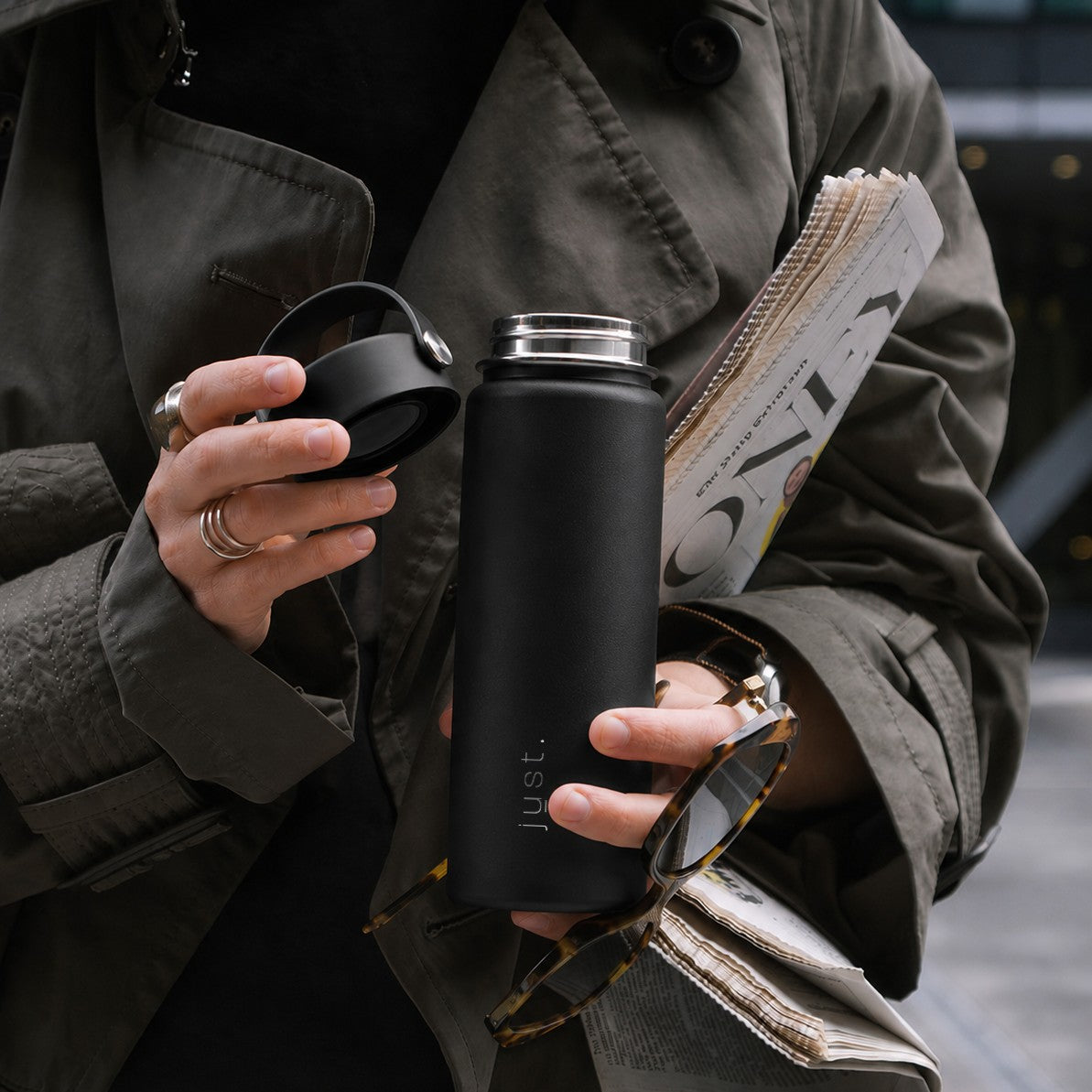
The people who stay hydrated are those who remove friction. Their bottle is easy to carry, easy to refill, easy to drink from and easy to keep close. That is why features that look small on paper matter in practice: integrated carry handles, leakproof lids and lightweight designs all increase the odds the bottle stays with you. Our Clipper Bottles were designed for exactly this: a built-in carabiner clip attaches the bottle to a backpack, festival bag or belt loop, so hydration is within reach all day without occupying a hand.
Beach days prove that cold water matters
Hydration advice focuses on how much people drink. Temperature matters too. Most people drink more when the water is refreshing. A bottle left on a towel for a few hours becomes unpleasantly warm, and that is usually when people stop drinking and start paying kiosk prices for something cold. Insulation changes the experience. A stainless steel bottle that keeps water cold for hours is a standing incentive to keep sipping. It is one reason larger insulated bottles have become so popular: the 1 L Nomad Bottle and 1.2 L Titan Tumbler carry enough for an afternoon and keep it cold long after the first refill. Our post on whether big water bottles make you drink more looks at when size helps and when it does not.
A summer day hydration checklist
- Start full. Fill with cold water and ice before leaving; an insulated bottle will still be cold at 4 pm.
- Carry at least 750 ml per person for an event with refills, 1 L or more where there are none.
- Drink on a schedule, not on thirst. Thirst lags behind need in heat; a few mouthfuls every 20 minutes beats a litre at once.
- Add electrolytes on long hot days, especially with alcohol in the mix; plain water alone is not enough after several hours of sweating.
- Refill when you pass a tap, not when the bottle is empty.
- Keep it attached or in sight. A clip, handle or shoulder strap stops the bottle being left under a seat.
- Rinse it that evening. Sun, sugar and a sealed lid are how a good bottle starts to smell; our guide to why a bottle smells after the gym applies to festivals too.
The real reason people use some bottles and ignore others
Most households already have at least one forgotten reusable bottle: in a cupboard, buried in a drawer, or long since donated. People rarely stop using a bottle because it can no longer hold water. They stop because something about it became inconvenient: hard to clean, leaks, does not fit the bag, an awkward lid. Or they never felt attached to it in the first place. The bottles people use consistently combine function with a sense of ownership. They feel good to carry, suit the owner's life and fit into routine. Our guide to the best water bottle for every type of person is built around that idea.
What brands can learn from Wimbledon
The Wimbledon bottle demonstrates something many businesses overlook: people are perfectly willing to carry a branded product every day if it genuinely adds value. Nobody buys the Wimbledon bottle to advertise Wimbledon. They buy it because they like the design, enjoyed the experience and want something useful. The branding becomes part of the appeal.
That is a real opportunity. A well-designed branded bottle stays visible for years. It travels to offices, gyms, airports, coffee shops, festivals and holidays. Unlike most promotional products, which vanish in weeks, a quality bottle earns repeated use. It is why businesses increasingly choose premium custom branded water bottles for employee onboarding, client gifts, conferences and events. At Just Bottle all branding is done in-house: precision laser engraving on stainless steel, ColourLift print with a raised tactile finish, 360-degree wrap print, Pantone matching for larger campaigns and custom lid colours to match brand guidelines. The goal is a product people want to keep using, not one left behind after the match. If you are planning an event, our sustainable event checklist covers the refill and bottle logistics.
Good hydration habits start with products people enjoy carrying
Whether you are watching tennis, dancing in a field or spending a day on the beach, the same thing applies: people drink more water when hydration feels easy. The bottle matters, the design matters, the experience matters. The most successful reusable bottles are rarely the ones with the longest spec sheet. They are the ones that fit naturally into everyday life. The Wimbledon bottle proves it every year: people remember it for the day it represents, not its capacity. The same idea applies whether you are choosing a bottle for yourself or creating one for your business. And every 100 bottles ordered from Just Bottle funds the collection of 10 kg of ocean-bound plastic through Plastic Bank, roughly 500 plastic bottles kept out of the sea.
Frequently asked questions
Can you bring a water bottle into Wimbledon?
Yes, reusable bottles are welcomed and there are free refill points around the grounds. Glass is not allowed and size limits can change year to year, so check the current conditions of entry before you go.
Can you take a reusable water bottle to a festival?
Almost always, if it is empty on entry; some festivals also allow sealed plastic bottles. Glass is banned everywhere. Refill points are provided but get busy, so fill whenever you pass one rather than when you run out.
How much water should you drink at a festival or in the sun?
Enough to replace what you sweat, which in hot weather can be 500 ml to 1 litre an hour when active. A practical rule is a few mouthfuls every 20 minutes and a full refill every two to three hours, with electrolytes on long days or if you are drinking alcohol.
What is the best water bottle for the beach?
A 1 litre or larger vacuum-insulated stainless steel bottle. It keeps water cold for the whole afternoon on hot sand, where an uninsulated bottle is warm within the hour, and it will not break if it is dropped on rocks.
Why do people buy the Wimbledon water bottle?
Because it ties a useful object to a day they enjoyed. The design changes each year, it is photographed and collected, and it keeps being used long after the tournament. It shows that branding works when the product is good enough that people want to carry it anyway.
What makes a good event water bottle for a brand?
Insulation so the water stays cold, a carry handle or clip so it stays with the person, a leakproof lid so it survives a bag, a size between 550 ml and 1 L, and branding applied in a way that lasts (engraving or a durable print) so it is still carried a year later.
Stay hydrated wherever summer takes you
From Wimbledon courts to festival fields and long days at the beach, the right bottle makes staying hydrated easier and more enjoyable. Explore our reusable water bottles and insulated tumblers, or our custom logo bottles if you want your brand carried long after the event ends.