

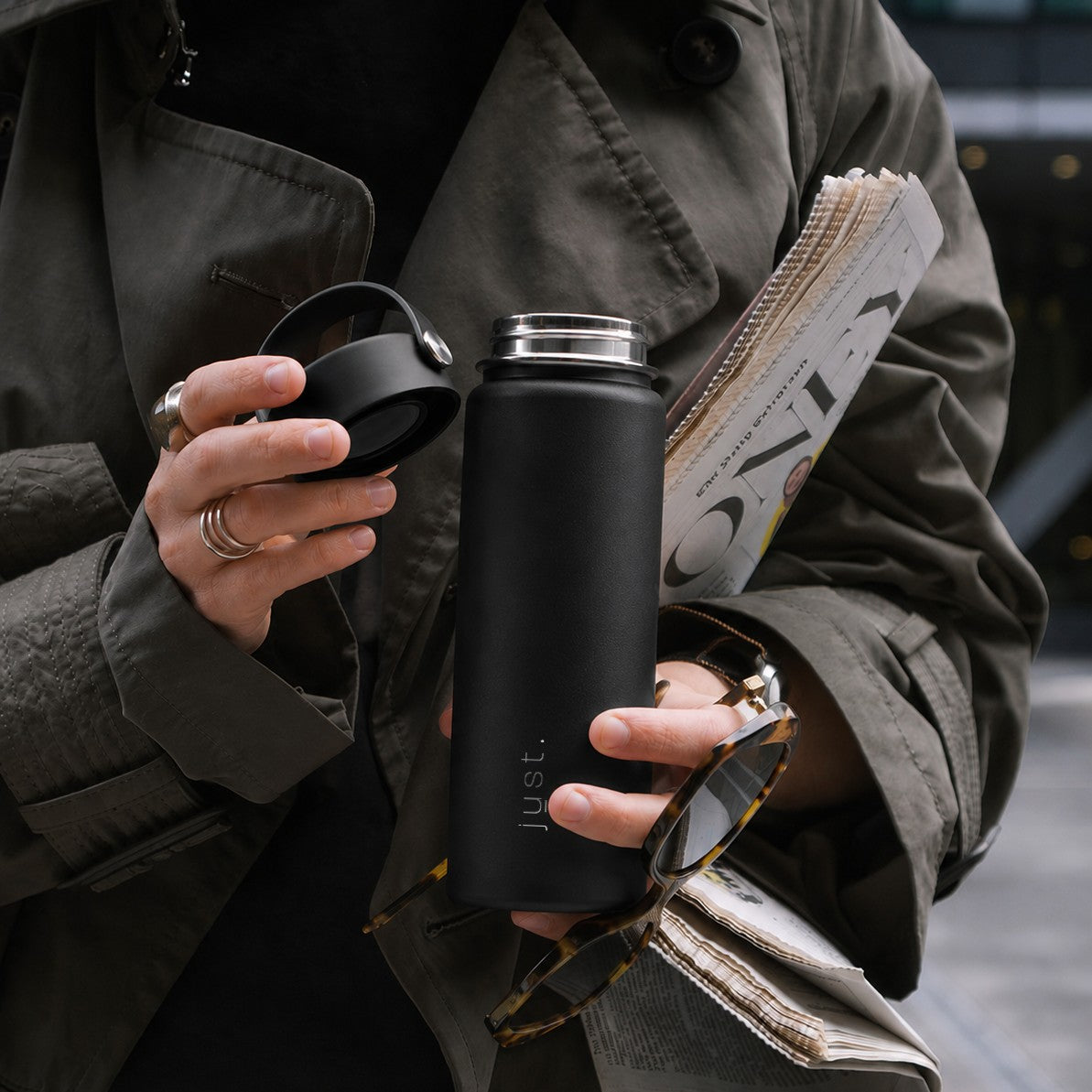

You put ice-cold water in your bottle, screw the lid on and leave it beside your laptop. Twenty minutes later the outside is covered in droplets and a suspicious ring is spreading across the desk. The first instinct is to check the lid. But the bottle probably is not leaking. What you are seeing is condensation, and the water on the outside did not come from inside the bottle. It came from the air around you.
Whether a reusable bottle ends up dripping depends on how easily the cold of the drink reaches the exterior. Material, construction and insulation all matter, which is why a single-wall bottle turns slippery while a vacuum insulated water bottle filled with exactly the same icy water stays dry. So where do the droplets come from, and what does a vacuum have to do with stopping them?
Short answer: condensation forms when a cold surface chills the air next to it below its dew point, so water vapour already in the air turns to droplets on the bottle. A vacuum insulated bottle has two steel walls with a near-vacuum between them; with almost no air in the gap there is nothing to carry heat by conduction or convection, so the outer wall stays at room temperature, no condensation forms, and the drink inside stays cold for up to 24 hours or hot for 12. Single-wall steel, glass and plastic bottles all sweat because their outer surface gets as cold as the drink.
How does condensation form on a water bottle?
Start with the air. It contains water vapour even though you cannot see it, and how much it can hold depends on temperature: warm air holds more moisture than cool air. Put a very cold single-wall bottle into that air. The cold surface chills the air immediately around it, and if that air cools to its dew point some of its invisible vapour turns to liquid. Tiny droplets collect on the bottle. That is condensation, the same process that steams a bathroom mirror, beads a cold window and wets a glass of iced water on a summer afternoon. The moisture is not passing through the bottle. It was already in the air.
Why do some water bottles sweat more than others?
Imagine pouring ice water into three bottles: single-wall stainless steel, glass, and vacuum-insulated stainless steel. The drink starts at the same temperature in all three. The outside does not. With single-wall metal there is very little between the cold drink and the exterior, and metal conducts heat well, so the outside quickly becomes cold enough for condensation. Glass does the same, more slowly. The vacuum-insulated bottle stays dry. A sweating bottle is not faulty, but it is telling you about heat transfer.
| Bottle type | Outer wall temperature with ice water inside | Condensation | Ice water still cold after | Comfortable to hold |
|---|---|---|---|---|
| Single-wall stainless steel | Close to the drink: 2 to 5 °C | Heavy within minutes in humid air | 1 to 2 hours | Cold and wet |
| Single-wall glass | Cold: 5 to 10 °C | Moderate | 1 to 3 hours | Cold |
| Single-wall plastic (rPET, Tritan) | Cool: 8 to 12 °C | Light to moderate | 1 to 2 hours | Cool |
| Double-wall glass (air gap) | Near room temperature | Little | 3 to 6 hours | Yes |
| Vacuum-insulated stainless steel | Room temperature | None in normal conditions | Up to 24 hours | Yes |
Figures are typical for a 500 to 750 ml bottle in a 22 °C room; exact times depend on ice, fill level and how often the lid is opened.
Why does condensation get worse in summer?
Humidity. When warm air holds plenty of moisture and meets a cold surface, condensation forms readily, which is why an icy drink is covered in droplets on a hot, humid day. The effect can be dramatic: take the same bottle from an air-conditioned office into warm outdoor air and the surface mists over in seconds. It also explains why a bottle sweats some days and not others. The drink is the same temperature; the surrounding air has changed. Understanding the science does not make the damp patch any less annoying, though. That is where insulation comes in.
How does vacuum insulation work?
A vacuum-insulated bottle does not stop the air around it holding moisture. It tackles the other half of the equation: the temperature of the bottle's exterior. Heat moves in three ways: conduction (through a material), convection (carried by moving air or liquid) and radiation. Vacuum-insulated drinkware has two stainless steel walls with the air pumped out of the gap between them. With almost no particles in that gap, conduction and convection across it fall close to zero. A reflective coating on the inner surfaces reduces radiation as well.
Fill the bottle with ice water and the inner wall gets cold, but that cold cannot readily cross the vacuum, so the outer wall stays close to room temperature. If the outside never gets cold enough to bring nearby air below its dew point, no condensation forms. No puddle, no wet hand, no damp ring next to the laptop. The only heat path left is the thin neck where the two walls join, which is why bottles lose temperature slowly rather than not at all, and why a good lid matters: most of the remaining heat loss is through the opening.
The same engineering keeps the drink cold
The insulation that prevents condensation also controls what happens inside. Heat moves from warm to cool, so with an uninsulated bottle heat from the room travels into the cold drink and warms it within an hour or two. Vacuum insulation slows that to a crawl. Our TempControl insulated stainless steel bottles keep cold drinks cold for up to 24 hours and hot drinks hot for up to 12, which is the same mechanism doing two jobs at once: holding the drink's temperature and stopping it reaching the exterior. That is why a good insulated bottle can hold ice water without feeling icy in the hand. Our post on the science of cold water explains why that matters for how much you drink.
Condensation or a leak? How to tell
You pull a damp bottle from your bag and assume the lid has failed. Before blaming the seal, look at where the moisture is. Condensation forms as small, even droplets across cold exposed surfaces. A leak originates at the lid, seal, straw opening or another point where liquid can physically escape, and tends to run or pool rather than mist. Test it: dry the bottle completely, fill it with cold water, and stand it upright on a paper towel. Droplets gradually appearing across the body mean condensation. Water collecting around the lid or running from one opening means a seal problem; our guide to how often to replace a reusable water bottle covers when a seal has had enough. With a properly vacuum-insulated bottle, condensation across the main body should not happen in normal conditions; if it does, the vacuum may have been breached by a hard knock, usually visible as a dent on the base.
What about reusable glass water bottles?
Glass appeals because it is a clean drinking surface that holds no flavour. But standard glass offers no thermal barrier: ice water makes the outside cold, and condensation follows. Double-wall glass with an air gap helps but does not match a vacuum, and glass carries the obvious consideration of breakability. For someone carrying a bottle between home, work, the gym, trains and airports, stainless steel offers the combination of durability and insulation. Glass suits a desk or bedside, where it stays put and a coaster solves the ring. Our buying guide to glass, stainless steel and recycled plastic weighs the trade-offs in full.
A dry bottle tells you something about its design
We judge insulation by the drink: is the water still cold, has the coffee stayed hot. The outside of the bottle tells the same story. If ice water can sit inside while the exterior is comfortable to hold and leaves no puddle, the insulation is doing its job. It is a small detail that becomes very noticeable after switching from an uninsulated bottle: no wet cup holders, no slippery bottle, no soggy papers, no rings on the furniture. Just cold water where it belongs.
Put the science to work
Next time you see condensation on a bottle you know where it came from: water vapour in the air met a cold surface and became liquid. The bottle did not create it and, assuming the lid is sound, did not leak it. Vacuum insulation changes the equation by separating the drink's temperature from the exterior's, so the drink stays cold without the bottle spending the afternoon sweating on your desk. Every 100 bottles ordered from Just Bottle also funds the collection of 10 kg of ocean-bound plastic through Plastic Bank, roughly 500 plastic bottles kept out of the sea.
Frequently asked questions
Why does my water bottle sweat?
Because its outer surface is cold enough to chill the surrounding air below its dew point, so water vapour in the air condenses on it. Single-wall steel, glass and plastic bottles all do this with cold drinks inside. The water comes from the air, not from the bottle.
How does a vacuum insulated water bottle work?
Two stainless steel walls with the air removed from the gap between them. With almost nothing in the gap to carry heat, the drink's temperature cannot reach the outer wall. The outside stays at room temperature, no condensation forms, and the drink stays cold for up to 24 hours or hot for up to 12.
Do vacuum insulated bottles sweat?
Not in normal use. If a vacuum-insulated bottle starts sweating across its body, the vacuum has probably been breached, usually by a hard drop that dented the base. The bottle is still safe to use but will no longer insulate.
How can I tell if my bottle is leaking or just condensation?
Dry it, fill it with cold water and stand it on a paper towel. Fine droplets spreading evenly over the body are condensation. Water appearing at the lid, seal or straw and running down or pooling is a leak, and the seal should be checked or replaced.
How long does a vacuum insulated bottle keep water cold?
Typically up to 24 hours for a quality bottle filled with ice water and kept closed; around 12 hours for hot drinks. Pre-chilling the bottle, adding ice and keeping the lid shut between sips extend the time.
Why does my insulated bottle stop keeping things cold?
Almost always because the vacuum has been lost after a dent, especially on the base. A tell-tale sign is the outside becoming cold and wet when filled with ice water. There is no repair; the bottle becomes a single-wall bottle.
Ready to keep the cold inside the bottle?
Explore our TempControl vacuum insulated water bottles and tumblers, designed for cold drinks, hot drinks and everything the day throws at them.