

What the rules require, and why many brands are switching to reusable
If you’ve searched for custom water bottle labels, you’re probably planning an event, a hotel amenity, a conference welcome pack or a corporate giveaway, and you want your branding on the bottle people pick up. It sounds simple: design a label, stick it on a bottle of water, hand it out.
It’s less simple than it looks. A label on a bottle of water isn’t only decoration. Bottled water is a packaged food product, so the label is a legal document with required information, and sustainability wording on it is now watched closely by regulators in the UK, EU and US.
This guide covers what a custom water bottle label has to include, the claims that get brands into trouble, and the alternative a growing number of hotels, event teams and corporate buyers choose instead: a branded reusable bottle, which carries no labelling obligations at all.
The short answer
If you’re labelling single-use bottled water, the label must carry the product name and type of water, the bottler or distributor’s name and address, the net volume, a lot or batch code, and any required source information, and every environmental claim on it must be specific and provable. If you want your brand on a bottle without any of that, a reusable bottle engraved or printed with your logo isn’t a food product and needs no label. For most hospitality, event and corporate uses, it is also the cheaper option per use and the one recipients keep.
What a custom water bottle label must include
Bottled water labelling is governed by food law. The exact rules differ by market (the UK’s Food Standards Agency and the Natural Mineral Water regulations, EU Regulation 1169/2011 on food information, and in the US the FDA standard of identity for bottled water in 21 CFR 165.110), but the core requirements overlap heavily.
| Requirement | Why it’s there | Typical format |
|---|---|---|
| Product name and water type | Tells the consumer what they’re drinking. “Spring”, “mineral” and “purified” are legally defined terms, not marketing words. | “Still Spring Water”, “Purified Drinking Water” |
| Bottler or distributor name and address | Legal responsibility and traceability | Company name and address on the label |
| Net volume | Required in nearly every market | “500ml”, “330ml”, “1L” |
| Lot or batch code | Recalls and quality checks | Printed or inkjet code on label or cap |
| Source information | Required for natural mineral and spring water in the UK and EU; US rules depend on the water type | “Source: [named spring]” or treatment statement |
| Recycling information | Required or expected in a growing number of markets | Resin code, recycling symbol, local scheme marks |
| Legibility | EU rules set a minimum x-height of 1.2mm for mandatory text; other markets expect clearly readable print | Clean sans-serif type with strong contrast |
Two things catch brands out. First, these rules apply whether or not the bottle is sold. A complimentary bottle in a hotel room or a conference bag is still bottled water placed on the market. Second, the legal responsibility sits with whoever puts their name on the label, so if you co-brand a bottler’s water, make sure the bottler’s details stay on it and that you have their labelling guidance in writing.
This is a summary for planning purposes, not legal advice. Your bottler, or the food standards authority in your market, is the right place to confirm the exact wording for a specific product.
The green claims trap
The fastest way to turn a nice label into a complaint is a vague environmental claim. Regulators have moved from guidance to enforcement:
- EU. The Empowering Consumers for the Green Transition Directive applies from September 2026. It bans generic environmental claims such as “eco-friendly”, “green” or “climate neutral” unless the claim is backed by recognised excellent environmental performance, and it bans sustainability labels that aren’t based on a certification scheme. (The separate Green Claims Directive, which would have added a pre-approval system, was withdrawn by the Commission in 2025, so the 2024 directive is the one that applies.)
- UK. The Advertising Standards Authority regularly upholds complaints against unqualified green claims, and the Competition and Markets Authority’s Green Claims Code sets the standard: claims must be truthful, clear, specific and substantiated, and must consider the full life cycle of the product.
- US. The FTC Green Guides govern environmental marketing claims. “Recyclable” is only allowed where recycling facilities are available to a substantial majority of consumers, and “biodegradable” claims need proof of complete breakdown within a reasonable time.
Claims that have been flagged in practice include “100% recyclable” on a bottle with a non-recyclable label or sleeve, “eco-friendly” with no evidence, and “biodegradable” where only one component is. The safe pattern is specific and verifiable: “Bottle made from 100% recycled PET (rPET)” is fine if it is true of the bottle body; it is not fine if the cap and label are virgin plastic and the claim implies otherwise.
Common mistakes on custom water bottle labels
- Missing bottler or distributor details. The most common breach, usually because the design team removed them for a cleaner look.
- Calling filtered tap water “spring water”. In the US and EU the terms are legally defined, and this one draws warning letters.
- No batch code. Without it, a recall means pulling everything.
- Illegible small print. Low-contrast text, print that wraps around a curve, or type below the minimum size.
- Generic green claims. See above. If you can’t show the evidence, don’t print the words.
- One label for several markets. GCC countries generally require Arabic, the EU and UK differ on source naming, and the US defines water categories differently. A label that passes in one can fail in another.
The alternative: a branded bottle with no label at all
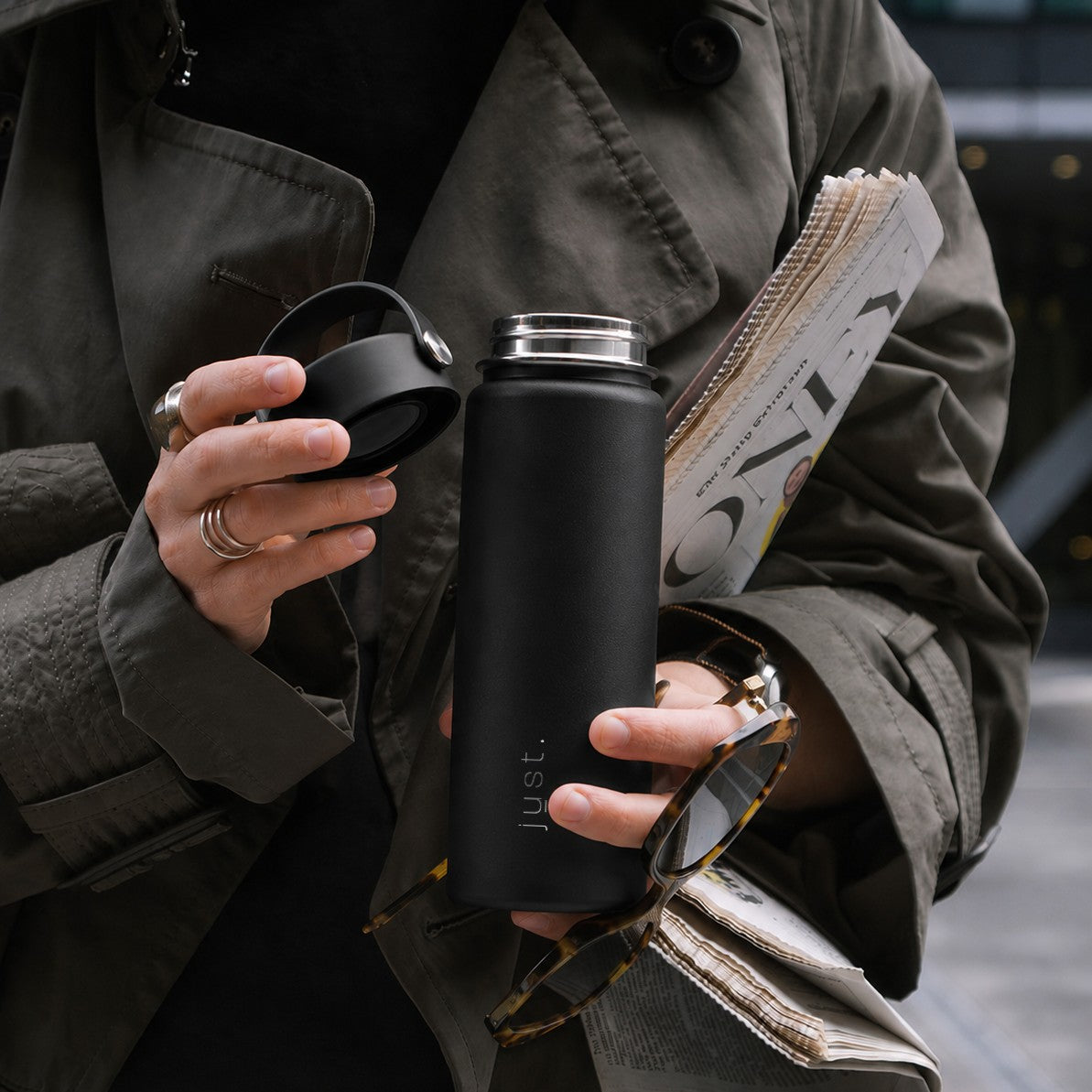
Here is the part most label guides leave out. Everything above exists because single-use bottled water is a food product. A reusable bottle with your logo engraved or printed on it is not. It is drinkware, so there is no mandatory label text, no bottler details, no lot code, no water-type definition and no risk of a green claim on the label because there is no label.
That is why hotels, event organisers and corporate teams have been moving from labelled water to custom water bottles with their logo. The compliance burden disappears, and a few other things improve at the same time:
- Cost per use. A labelled 500ml bottle is used once. A reusable bottle is used daily for years, so the cost of putting your brand in someone’s hand drops with every refill.
- Brand retention. Labelled water goes in the bin within an hour. A well-made bottle goes home, to the office and to the gym. Our post on why custom water bottles make the perfect corporate gift covers the numbers.
- Waste and ESG reporting. Single-use bottled water is one of the largest avoidable waste streams in hospitality and events. Replacing it with a reusable bottle is a measurable line in a sustainability report; see which industries create the most water bottle waste.
- Verified impact instead of a claim. Every 100 bottles ordered from Just Bottle funds the collection of 10kg of ocean-bound plastic through Plastic Bank. That is a third-party verified figure you can put in a report, which is the kind of specific, substantiated statement regulators want to see.
Labels vs printing vs laser engraving: how branding compares
| Stick-on label (bottled water) | Printed reusable bottle | Laser-engraved reusable bottle | |
|---|---|---|---|
| Legal labelling required | Yes | No | No |
| Lifespan of branding | One use | Years; print can wear with heavy use | Permanent |
| Colour | Full colour | Full colour, Pantone matched | Tone-on-tone, premium look |
| Minimum order | Often 500 to 1,000+ | From around 50 | From around 50 |
| Waste per unit | Bottle, cap and label | None after delivery | None after delivery |
| Best for | Short events where reuse isn’t practical | Fitness, education, colourful brands | Hospitality, corporate, professional services |
If you’re choosing between printing and engraving for your own logo, our guide to how to custom design water bottles goes into placement, colour and finish.
When labelled bottled water still makes sense, and how to do it well
There are situations where a reusable bottle isn’t the right fit: a one-day public event with thousands of attendees, a venue with no refill points, or a market where sealed water is expected for hygiene reasons. If that is your situation:
- Work with a bottler who supplies the compliant base label and lets you add branding around it, rather than designing the whole label yourself.
- Keep legal text in a dedicated panel in the lower third of the label, in a clean sans-serif at or above the minimum size, with strong contrast.
- Make the design modular so the compliance panel can be swapped per market without redrawing the brand panel.
- Put the sustainability story behind a QR code that links to evidence (material certificates, impact data) rather than printing claims on the label. The same QR approach works on reusable bottles.
- Pair it with refill. Hand out labelled water at the door and a reusable bottle for the rest of the event; our sustainable event checklist shows how.
Frequently asked questions about custom water bottle labels
Do I need to follow food labelling rules if the water is free?
Yes. Bottled water given away in a hotel room, at a conference or at an event is still placed on the market, and the same labelling requirements apply as if it were sold.
What has to be on a custom water bottle label?
At minimum: the product name and type of water, the bottler or distributor’s name and address, the net volume, a lot or batch code, source information where the water type requires it, and clear recycling information. Exact wording varies by market, so confirm with your bottler.
Can I put “eco-friendly” or “100% recyclable” on the label?
Only if you can prove it for the whole product. From September 2026 the EU bans generic claims like “eco-friendly” unless backed by recognised certification, and the UK and US already require claims to be specific and substantiated. “Bottle made from 100% rPET” is acceptable when it is true of the bottle body.
Is a reusable branded water bottle subject to the same rules?
No. A reusable bottle with your logo is drinkware, not a food product, so there is no mandatory label. The bottle itself should still meet food-contact material standards such as LFGB in Europe or FDA requirements in the US, which a reputable manufacturer will certify.
Which is cheaper, labelled bottled water or custom reusable bottles?
Per unit, bottled water is cheaper. Per use, a reusable bottle wins quickly because it is used hundreds of times. For a recurring programme (hotel rooms, onboarding, memberships) reusable is almost always the lower cost over a year.
What is the minimum order for custom reusable water bottles?
Typically 50 to 100 units for engraved or printed stainless steel, compared with 500 to 1,000 or more for a custom-labelled bottled water run. See our guide to how to order custom water bottles in bulk for the full process.
Put your brand on something people keep
A compliant label on bottled water is achievable, and if you need one, the checklist above will keep you out of trouble. But if the goal is to put your brand in people’s hands at an event, in a hotel room or on day one of a new job, a reusable bottle does it without a single line of legal text, and it is still being used long after the event ends.
Explore our custom logo water bottles in recycled stainless steel and 100% rPET, with laser engraving or full-colour printing, low minimums and verified ocean plastic collection built into every order.