

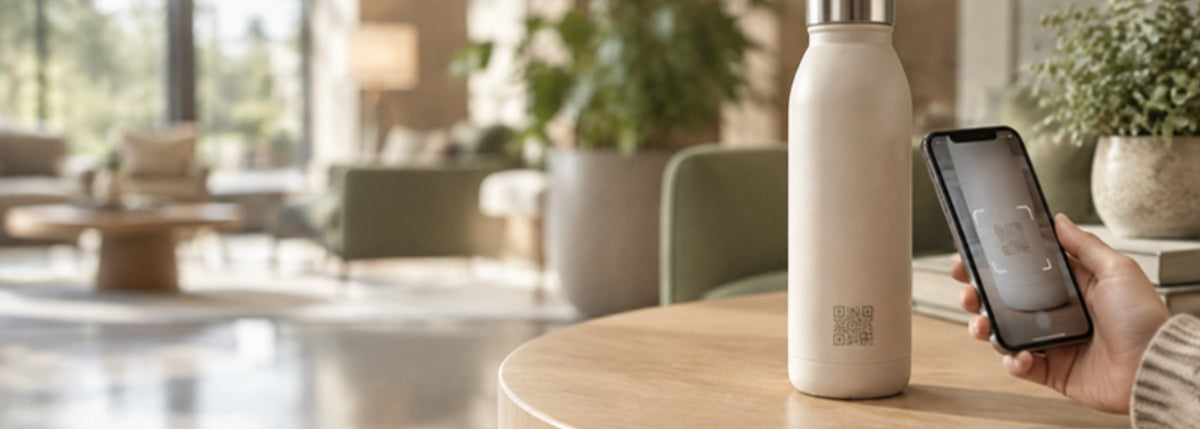
Turning branded bottles into connected, traceable products
A few years ago, branded water bottles were simple — choose a colour, print a logo, hand them out. Done. But expectations have changed. A Booking.com global sustainability report found that 76% of travellers want brands to offer more sustainable options, and Clean the World reports that 88% of hotel guests now consider sustainability when choosing where to stay. That includes something as everyday as a water bottle.
At the same time, governments have been tightening ESG requirements. The EU’s Digital Product Passport (DPP) now makes product traceability mandatory across multiple sectors from as early as 2026. And in hospitality, wellness, fitness and corporate gifting, brands are already adapting — not just for optics, but to stay relevant and compliant.
That’s where private label water bottle manufacturers using QR and smart technology make a real difference. They’re helping brands turn a bottle into a digital experience: scan to see material origins, track ocean plastic removed, access loyalty rewards, or find nearby refill stations.
In this guide, we’ll explore how QR and NFC technology is reshaping private label water bottles — and what to look for in a water bottle manufacturer if you want your bottles to be traceable and future-ready. If you’re still at the supplier-selection stage, our guide to choosing the right white label water bottle manufacturer covers the fundamentals of quality, MOQs and timelines.
Traceability is the new standard in private label bottled water
The era of anonymous, mass-produced bottled water is coming to an end. People want to know where things come from and who they affect along the way. This is especially true in industries that pride themselves on care and hospitality — like boutique hotels, wellness retreats, fitness studios and corporate events.
That’s where traceability is leading the way. With QR codes or NFC tags, a bottle becomes more than a simple branded object. It becomes a digital touchpoint.
With a simple scan, you can show:
- Where the product was made
- How much ocean plastic was removed with the purchase
- Which materials were used — rPET, stainless steel, ceramic-lined Reclaim bottles
- Impact data tied to ESG reports or sustainability pages
It also works in your favour from a regulatory perspective. As ESG reporting becomes mandatory across Europe and other regions, traceable merchandise makes data collection easier. It builds trust and avoids accusations of greenwashing. Which nobody wants.
What QR and NFC technology can unlock for your brand
By adding a QR code or NFC chip, a private label bottle becomes what’s often called a digital product passport — an object with a physical form and a digital life.
Here’s what that looks like in practice:
| Feature | What it enables |
|---|---|
| Provenance | Scan to view water source, recycled material content or local impact projects |
| Sustainability impact | Show how many kilos of ocean plastic were removed, CO₂ saved or communities supported |
| Guest engagement | Link to spa menus, gym class bookings, check-in details or loyalty perks |
| Refill & reuse culture | QR shows local refill stations or tracks personal plastic savings |
| Corporate gifting | Include personalised CEO messages, onboarding links or impact certificates |
| Loyalty & retention | Scan to earn points, unlock discounts or rebook a future stay or class |
These features aren’t gimmicks. They create a direct bridge between you and the user, long after check-in or check-out.
QR code vs NFC: which is right for your bottles?
Both do a similar job — connecting a physical bottle to a web page — but they suit different budgets and use cases.
- QR codes are the practical default. They can be laser-engraved or printed directly onto the bottle, cost almost nothing per unit, and work with any smartphone camera. They’re the right choice for most hotel, gym and corporate gifting programmes.
- NFC tags are a small chip embedded in the bottle, base or lid. A tap (rather than a scan) opens the link. They feel more premium and are harder to copy, but they add cost per unit and complicate manufacturing. They make sense for high-value gifting or limited runs where the “tap” moment is part of the experience.
Whichever you choose, the important part is what sits behind the code: a landing page you control and can update at any time, without touching the bottles already in circulation.
What to look for in a private label water bottle manufacturer
Not every water bottle manufacturer can support traceable or QR-enabled bottles. If you're considering launching your own, these are the questions to ask:
1. Do they support unique QR/NFC codes at scale?
Some suppliers can only print one QR design across all bottles. The better ones support variable coding, where each bottle has its own unique, trackable digital ID.
2. Can they customise digital experiences by use case or region?
Hotels in Bali may want QR codes leading to refill stations and spa menus. A German wellness retreat might want the code linked to EU-compliant sustainability reporting. Ask if they allow different landing pages or campaign versions.
3. How do they apply QR codes — print, laser or embedded?
Durability matters. Printed codes can wear off. Laser engraving or UV-cured digital printing lasts longer and is scannable even after months of use.
4. Do materials support longevity and brand feel?
Look for options like:
- Stainless steel bottles with TempControl™ insulation
- Reclaim bottles (stainless steel + part recycled ocean plastic + ceramic lining)
- 100% rPET recycled plastic bottles
These aren’t just trends — they reflect the values of your business and your guests.
5. Can they certify ethical sourcing?
Ask about LFGB, FDA compliance, recycled content certificates, or BSCI/SMETA audits for fair labour. We’ve written more on why this matters in our piece on ethical merch sourcing.
At Just Bottle, we already integrate impact tracking with each order — every bottle funds the collection of 1kg of ocean-bound plastic and supports women working in coastal cleanup communities. That impact can be communicated through laser-etched QR codes on the bottles or on packaging cards. Read more about how our impact model works.
How to launch QR-enabled private label bottles in five steps
If you’re working with a water bottle manufacturer for the first time, this is roughly how a QR-enabled project runs from brief to delivery:
- Decide what the scan should do. One destination (an impact page) or many (refill map, spa menu, onboarding pack)? This decides whether you need a single code or unique codes per bottle.
- Build the landing page first. Keep it mobile-first in design, fast to load and editable. Use a short branded URL or a redirect you control, so the code never goes dead if the page moves.
- Choose the application method. Laser engraving for permanence, UV print for colour, or an NFC insert for a premium tap experience. Your manufacturer should advise on minimum code size and contrast so it scans reliably on a curved surface.
- Approve a scanned sample. Don’t sign off on a mockup. Ask for a physical pre-production sample and test the scan on a few different phones in normal lighting.
- Track and iterate. Use the scan data — how many, where, when — to refine the page and report on engagement. The bottles stay the same; the experience behind them keeps improving.
Budget-wise, adding a QR code adds very little to the unit price. For a sense of the baseline, see our guide to how much custom branded water bottles cost.
Real-world impact — from marketing to measurable ROI
So, does any of this actually work in practice?
Yes — and here’s how.
Hotels & resorts
Boutique hotels report higher return bookings when QR-enabled bottles link to spa offers, loyalty perks or rebooking discounts. Guests take the bottles home — extending the brand experience beyond the stay. It’s one of the reasons private label water bottles have become a hospitality essential.
Gyms and wellness studios
Members scan bottles to:
- Access class timetables
- Redeem member rewards
- Log hydration or CO₂ saved through refilling
This creates community, retention and social media visibility.
Corporate gifting
Instead of a standard “thanks for attending,” QR codes link to:
- Welcome videos from CEOs
- ESG breakdowns: “Your bottle helped remove 2,000 plastic straws from the ocean”
- Digital onboarding packs
The result? Higher employee engagement, better brand loyalty and reduced waste. If you’re planning bottles for a conference, our sustainable event checklist covers the rest of the setup.
Data for ESG and sustainability reporting
Some brands even track:
- Number of scans
- Total refills logged
- Total single-use plastic saved
- Tonnes of CO₂ avoided
Frequently asked questions about QR-enabled private label water bottles
What is a private label water bottle manufacturer?
A private label water bottle manufacturer produces reusable bottles that are branded and sold under your company’s name rather than the manufacturer’s. You choose the material, colour, finish and logo application; they handle production, quality control and, increasingly, digital features like QR codes.
Can any water bottle manufacturer add a QR code?
Most can print a single, identical QR code across a run. Fewer can laser-engrave codes for durability, and fewer still can produce unique codes per bottle for item-level tracking. Ask specifically about variable (serialised) coding if traceability or per-bottle data matters to you.
Will a laser-engraved QR code still scan on a curved stainless steel bottle?
Yes, provided the code is sized correctly and has enough contrast against the finish. Powder-coated bottles with a light engraving generally scan well; polished bare steel is harder because of glare. A good manufacturer will test this on a sample before production.
What should the QR code link to?
Start with one clear destination tied to your goal — an impact page for ESG, a refill map for hotels, a class booking page for gyms, an onboarding pack for new hires. Use a redirect you control so you can change the destination later without reprinting bottles.
Is a QR code enough to meet Digital Product Passport requirements?
A QR code is the delivery mechanism, not the passport itself. DPP compliance depends on the data behind the code — materials, origin, recyclability and so on — meeting the EU’s requirements for your product category. Bottles aren’t among the first categories covered, but a traceable setup now puts you ahead of the curve.
Does adding a QR code increase the minimum order quantity?
Not usually. A single engraved or printed code is treated like any other logo element. Unique codes per bottle or NFC inserts may carry a small setup fee or a modest MOQ, so confirm this with your supplier when quoting.
Bottles that carry the weight of our planet
Private label water bottles are evolving into communication tools — packaging sustainability stories, product traceability, guest perks and digital convenience into one object people actually use.
Hotels, gyms, retreats and corporate teams aren’t ordering bottles just to “look good” anymore. They want objects that reflect their values and connect the physical experience to a digital one.
If you’re ready to create bottles that do exactly that — aesthetic, traceable and impact-driven — explore our custom water bottles for business.
Let your next bottle stay on-brand and work hard. Let it start conversations, build loyalty and travel further than the first sip.